

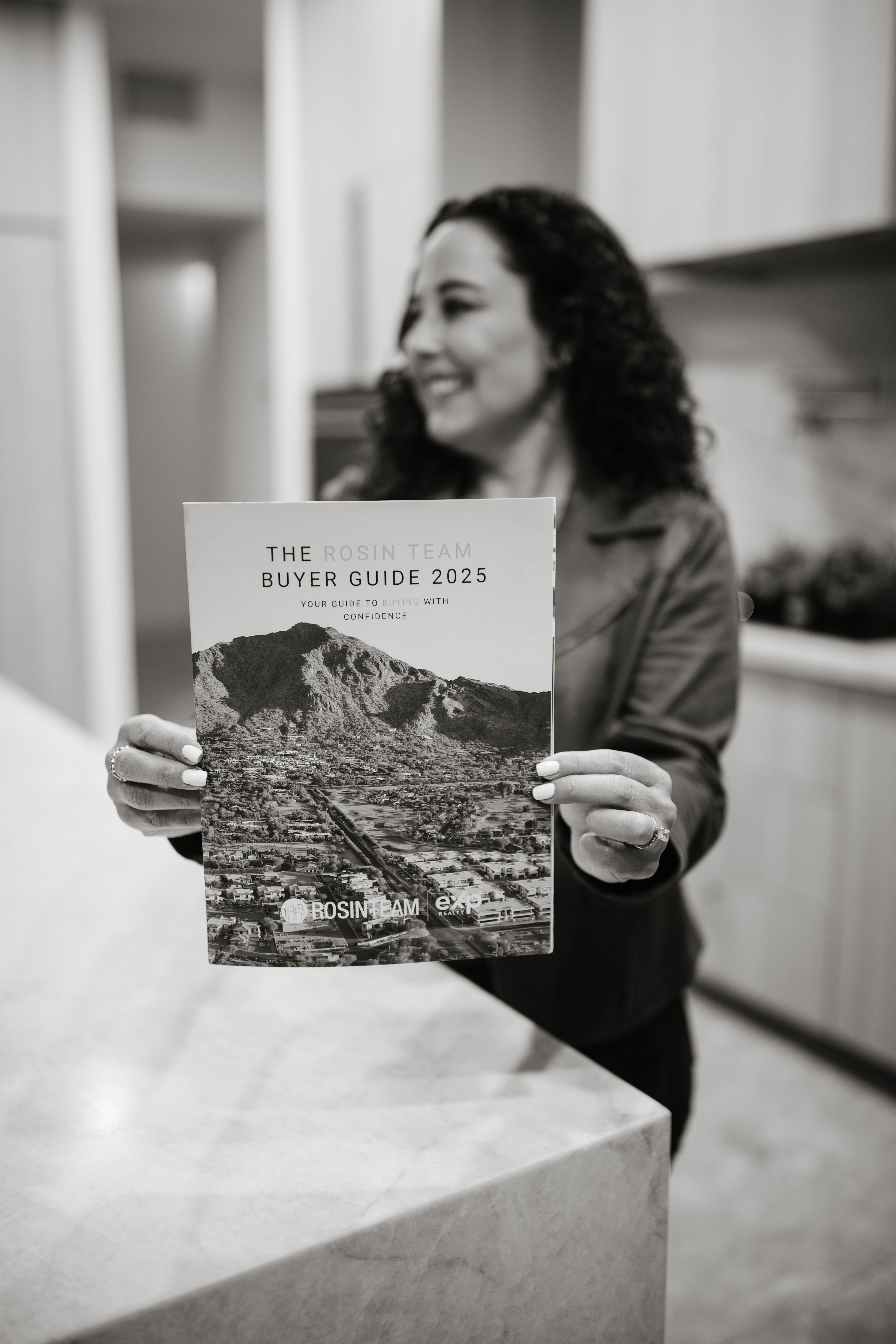
Buying your first home is one of the largest financial decisions you will ever make. It is also one of the most emotionally charged. The Phoenix market moves quickly, inventory shifts by submarket, and the gap between what buyers expect and what the process actually looks like can cost time, money, and the right house.
This guide covers what you need to know before you start — not after you are already under contract.
Step one: Get pre-approved before you fall in love with a house
In the Phoenix metro, a serious offer without a pre-approval letter rarely wins. Sellers are not required to entertain buyers who have not demonstrated financing ability, and in competitive submarkets — Scottsdale, Arcadia, Ahwatukee, parts of Gilbert and Chandler — you may have 24 to 48 hours to submit after a listing hits the MLS.
A pre-approval is not a pre-qualification. Pre-qualification is a soft estimate based on self-reported numbers. Pre-approval means a lender has pulled your credit, reviewed your income documentation, and issued a conditional commitment to lend up to a specific amount.
What you will need for pre-approval:
- Two years of W-2s or tax returns if self-employed
- Two to three months of bank statements
- Pay stubs from the last 30 days
- A government-issued ID
The pre-approval process typically takes three to five business days. Do not make any large purchases, open new credit lines, or change jobs between pre-approval and closing — all of these can cause a lender to rescind the commitment.
Step two: Understand what your payment actually includes
First-time buyers often anchor to the purchase price. The monthly payment is the number that governs your daily life.
A Phoenix-area mortgage payment typically includes four components, sometimes called PITI:
Principal. The portion of your payment that reduces the loan balance.
Interest. The lender’s cost of lending you money. On a 30-year fixed loan, the early years of your payment are weighted heavily toward interest. On a $500,000 loan at 7 percent, your first payment is roughly $2,661 in interest and $672 in principal.
Taxes. Arizona property taxes are paid in two installments annually, but lenders collect one-twelfth of the annual amount each month into an escrow account. In Maricopa County, effective property tax rates average around 0.5 to 0.7 percent of assessed value annually.
Insurance. Homeowner’s insurance protects the structure. In Arizona, this typically runs $1,200 to $2,000 per year for a standard single-family home, though homes in higher-value areas or with pools will run higher.
If your down payment is less than 20 percent, you will also owe private mortgage insurance (PMI), which adds $100 to $300 per month depending on loan size and credit score.
Step three: Know your true out-of-pocket costs
The down payment is not the only cash you need at closing. First-time buyers are often caught off guard by closing costs, which in Arizona typically run 2 to 3 percent of the purchase price on top of the down payment.
On a $450,000 home with 10 percent down ($45,000), your total cash needed at closing is closer to $55,000 to $60,000 after factoring in lender fees, title insurance, escrow fees, and prepaid items like homeowner’s insurance and the initial escrow deposit.
Arizona also offers down payment assistance programs through the Arizona Department of Housing, which can reduce upfront cash requirements for qualifying buyers.1
Step four: Choose the right submarket for your life, not just your budget
Phoenix is not one market. It is a collection of distinct submarkets, each with different price points, commute profiles, school districts, and appreciation trajectories.
Scottsdale. Higher price point. Strong appreciation history. Proximity to employers in the North Scottsdale tech and healthcare corridor.
Gilbert and Chandler. Family-oriented. Strong school districts. Significant employer base including Intel in Chandler and growing medical infrastructure in Gilbert.
Surprise and Goodyear. More affordable entry points. Growing infrastructure. Longer commute to central Phoenix but improving with Loop 303 development.
Tempe and Mesa. Urban density, proximity to ASU and light rail, mixed housing stock from historic to new construction.
The submarket where you buy affects not just your commute but your resale audience. Lauren Rosin advises first-time buyers to think about who will buy this home from you in seven to ten years — and whether that buyer pool is growing or shrinking.
Step five: Work with an agent before you need one
The single most common mistake first-time buyers make is contacting a listing agent directly on a home they found online. The listing agent represents the seller. Their fiduciary duty is to maximize the seller’s outcome — not yours.
A buyer’s agent costs you nothing in most transactions. The seller pays the commission. What you get is representation, market knowledge, negotiation on your behalf, and someone whose job is to find problems with the home before you own them.
Start the agent relationship before you start the search. The right agent will help you define your criteria, alert you to off-market or pre-list opportunities, and prepare you for what the offer process looks like in real time — not in theory.
Bottom line
Buying your first home in Phoenix is a navigable process when you understand the sequence: financial clarity first, market knowledge second, property search third. Buyers who reverse that order spend months looking at homes they cannot afford or in submarkets that do not fit their life.
The market rewards prepared buyers. Start with the paperwork, not the Zillow scroll.
Footnotes
Footnotes
-
Arizona Department of Housing, Home Plus Program. Down payment assistance for qualified Arizona buyers. https://housing.az.gov/general-public/home-plus-program ↩